Property Management Company vs Self-Management: Which Is Better?

Every landlord reaches this crossroads at some point. You either manage your rental property yourself or you hand it over to a property management company that handles the work for you. Both paths can lead to good returns, but they come with very different demands on your time, your patience, and your risk tolerance. In this guide, we break down what each option really involves so you can decide which one fits your situation as a landlord in Dubai.
There is no single right answer here. A landlord with one apartment and plenty of free time may manage perfectly well alone, while an owner with several units across the city or living outside the UAE may find self-management unworkable. What matters is understanding the actual trade-offs rather than assuming one path is automatically better than the other.
At 2ndhome, our team of property managers speaks with landlords every week who are somewhere in the middle of this decision, and the same questions tend to come up again and again. This article walks through those questions honestly, covering time, cost, legal responsibility, and long-term returns, so you can make a choice that actually suits your property and your lifestyle.
What Self-Management Actually Involves
Self-management means the landlord personally handles every part of running the rental property. There is no middle party, which sounds simple on paper but carries a long list of responsibilities in practice.
Daily and Weekly Tasks
A self-managing landlord typically deals with tenant inquiries, rent collection, maintenance requests, and property inspections without any outside support. During busy periods, this can turn into several hours of work each week, even for a single unit.
Tools Landlords Rely On
Many self-managing landlords use a mix of spreadsheets, messaging apps, and personal networks of contractors to keep things running. Without dedicated software or a team behind them, coordination often depends on the landlord being personally available and responsive.
Who Self-Management Tends to Suit
- Landlords with one or two properties located near where they live
- Owners who enjoy hands-on involvement and have time to spare
- Landlords who already have reliable local contacts for repairs
- Those who are comfortable handling tenant disputes directly
What a Property Management Company Handles
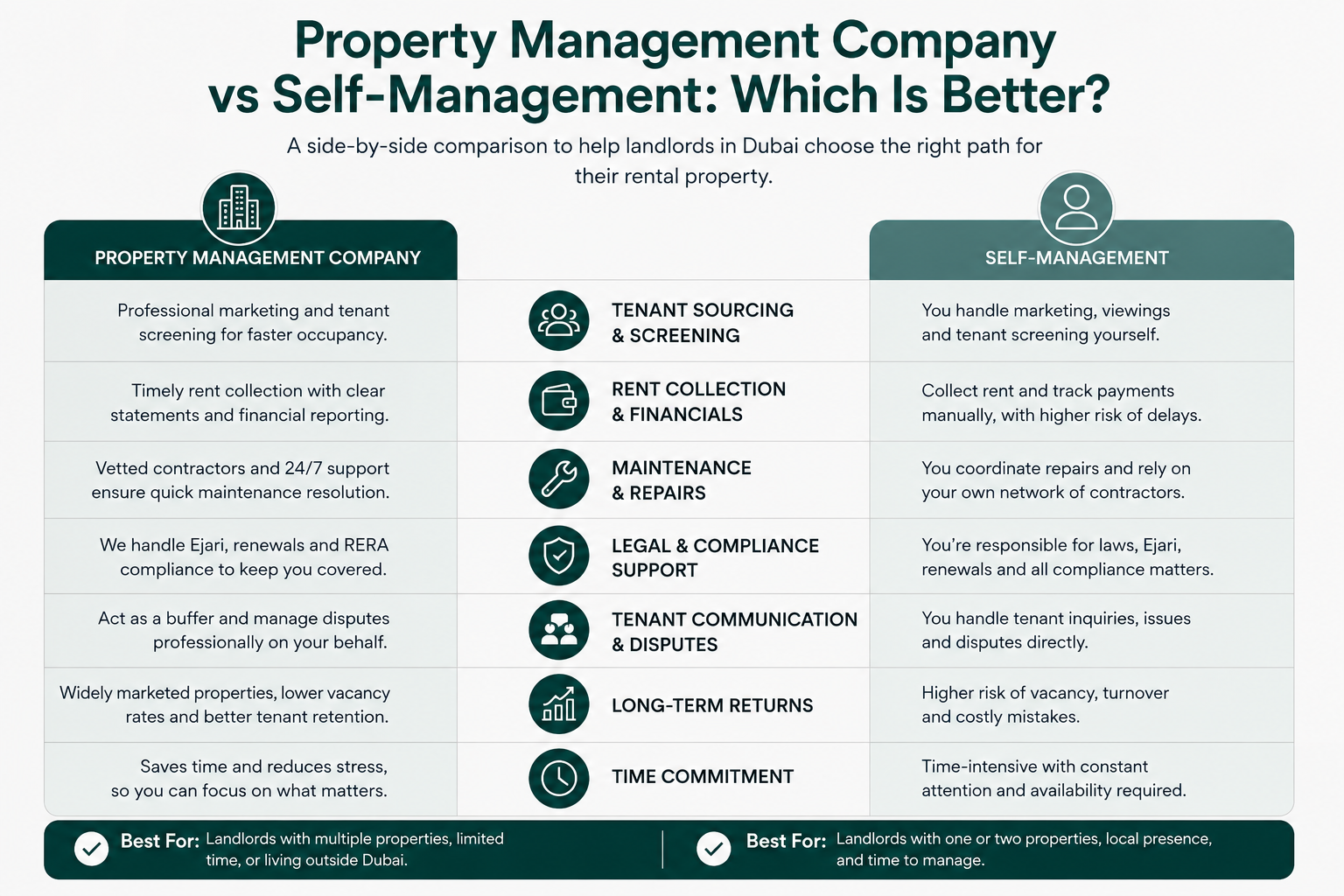
A property management company takes over the operational side of running a rental property, acting as the point of contact for tenants while keeping the owner informed through regular updates.
Tenant Sourcing and Screening
This includes marketing the property, conducting viewings, verifying tenant documents, and negotiating lease terms on behalf of the owner. Good property managers UAE-wide tend to have established networks that help fill vacancies faster than an individual landlord managing alone.
Rent Collection and Financial Handling
Rather than chasing payments personally, landlords receive collected rent along with clear statements showing income, deductions, and any outstanding matters. You can see how a rental management company structures its listing and tenant matching process through our approach to marketing rental homes in Dubai.
Maintenance Coordination
Property management companies typically maintain a network of vetted contractors for plumbing, electrical work, air conditioning, and general repairs, which usually means faster response times than a landlord relying on ad hoc callouts.
Legal and Compliance Support
From Ejari registration to lease renewals and RERA-related requirements, a management company keeps track of dates and paperwork that are easy for an individual landlord to overlook amid other responsibilities.
Comparing Time Commitment
Time is often the deciding factor for landlords weighing these two options, so it deserves a closer look.
The Reality of Self-Management Hours
Even a well-behaved tenancy requires periodic attention, and problems rarely arrive at convenient moments. A burst pipe at midnight or a tenant dispute over a deposit does not wait for a landlord's schedule to clear up.
What Delegation Actually Frees Up
Handing operations to a property management company shifts these demands away from the owner. Landlord services typically include round-the-clock tenant support, which means owners are no longer the first call when something goes wrong at the property.
A Simple Way to Weigh It
Ask yourself honestly how many hours a month you can realistically give to your rental property, and whether those hours are better spent elsewhere, whether that is your career, your family, or simply your own time.
Comparing Costs
Cost comparisons are rarely as straightforward as they first appear, since self-management has hidden costs that are easy to underestimate.
Property Management Company Fees
Most companies charge a percentage of monthly rent, commonly falling between five and ten per cent for standard residential management, with additional charges sometimes applying for tenant placement or renewal services.
The Hidden Cost of Self-Management
- Time spent handling inquiries and viewings that could go toward paid work
- Higher risk of vacancy periods due to slower marketing reach
- Emergency repair costs that are often higher without an established contractor network
- Potential legal costs if compliance requirements are missed
Looking at the Bigger Picture
A management fee can feel like an added expense at first glance, but it needs to be weighed against reduced vacancy time, fewer costly mistakes, and the value of the landlord's own time. For many owners, particularly those with multiple properties, the numbers tend to favour professional management once these factors are properly accounted for.
Comparing Risk and Legal Responsibility
Rental property ownership comes with legal obligations that carry real consequences if handled incorrectly.
What Falls on the Landlord in Self-Management
An individual landlord is personally responsible for staying current with tenancy laws, ensuring contracts are properly registered and handling disputes in line with RERA regulations. Mistakes here can lead to delays, financial penalties or difficulty enforcing lease terms later on.
How a Rental Management Company Reduces Exposure
Established companies generally have processes built specifically around compliance, which reduces the chance of an overlooked renewal date or an improperly drafted clause. This does not remove all risk, but it does shift a meaningful share of that responsibility onto a team that handles these situations regularly.
Tenant Disputes
Disputes over maintenance responsibility, deposit deductions, or lease terms are rarely enjoyable to handle personally. A management company acts as a buffer, managing these conversations on the landlord's behalf while keeping the owner informed of the outcome.
Comparing Long-Term Returns
Beyond monthly cash flow, the choice between these two approaches can shape a property's performance over several years.
Vacancy Rates
Properties marketed through an established network and multiple channels tend to fill vacancies faster than individual listings, which directly protects annual rental income.
Property Condition Over Time
Regular inspections and prompt maintenance response help prevent small issues from becoming expensive repairs, which supports the property's condition and its resale value down the line.
Tenant Retention
Professional communication and responsive maintenance handling tend to encourage tenants to renew rather than move elsewhere, reducing the turnover costs that come with finding new tenants repeatedly.
Questions to Ask Before Deciding
Before settling on either path, it helps to run through a short set of honest questions about your own situation.
- How many hours can I realistically commit each month
- Do I have reliable contractors already in place
- How comfortable am I handling legal and compliance matters personally
- Would my time be better spent elsewhere financially
- How many properties am I managing, and is that number likely to grow
If the answers point toward limited time, multiple properties, or discomfort with legal detail, a property management company is generally the more practical route. If you have one property, plenty of availability, and enjoy the hands-on process, self-management may continue to work well for you. Learn more about how we approach landlord services by reading our story, where you can see the values and experience behind our work at 2ndhome.
Making the Right Choice for Your Property
There is no universal answer that applies to every landlord, and that is worth repeating. A single apartment managed by an owner living nearby with spare time is a very different situation from a portfolio of units spread across the city with an owner based overseas. The right choice depends on your specific circumstances rather than a general rule.
What matters most is being honest about your available time, your comfort with legal responsibility, and what you genuinely want from property ownership. Some landlords value control and hands-on involvement above all else. Others simply want steady returns without the operational load, and that is exactly the gap a rental management company is designed to fill.
Final Thoughts
Choosing between a property management company and self-management ultimately comes down to weighing your time, your risk tolerance, and what kind of landlord you want to be. Neither option is inherently superior, but one is usually a better fit for your specific property and lifestyle.
If you are still weighing your options or want a clearer picture of what professional management could mean for your property, our team would be glad to talk it through with you. Feel free to reach out to our team, and we can help you figure out the best path forward.
Frequently Asked Questions
1. Is a property management company worth it for a single property?
It depends on your available time and comfort with tenant matters. Owners with limited time or those living outside the UAE often find it worthwhile even for a single unit.
2. How much do property managers in the UAE typically charge?
Fees commonly range between five and ten per cent of monthly rent for standard residential management, though this can vary based on the services included.
3. Can I switch from self-management to a property management company later?
Yes, landlords can transition at any point, and most management companies handle the transfer of existing tenancies with minimal disruption.
4. What happens to my existing tenants if I hire a management company?
Existing leases generally remain in place, with the management company simply taking over communication, rent collection, and maintenance coordination going forward.
5. Do property management companies handle Ejari registration?
Most established companies manage Ejari registration and renewal as part of their standard landlord services, along with other compliance requirements.
6. Is self-management riskier than using a rental management company?
Self-management carries more personal exposure to compliance mistakes and tenant disputes, since there is no dedicated team handling these matters on the landlord's behalf.
7. How do property managers UAE-wide find tenants faster than individual landlords?
They typically use established marketing channels, professional listings and existing networks that reach a wider pool of prospective tenants than a single landlord managing alone.
8. Will a property management company reduce my rental income?
The management fee is offset in many cases by reduced vacancy periods, fewer costly maintenance issues, and stronger tenant retention over time.
9. What should I look for when choosing a property management company?
Look for transparent fees, clear reporting, a strong local network of contractors and a track record of managing properties similar to yours.
10. Can a property management company help with multiple properties across different areas?
Yes, this is one of the main advantages for landlords with a growing portfolio, since centralised management becomes far more practical than handling each property individually.